

What are you doing here in the campo (rural area) when you speak Spanish, Quechua and English?
Remigio Ancalle
Bolivia 1992 – 2011
I remember in 1993 arriving in a community called Aiquile in the high valleys of Bolivia. I was contracted by an NGO (non-governmental organization) that was funded by the USAID in order to decrease coca production in the Chapare area of the country. Coca is the precursor of cocaine and an illegal crop. The goal was to reduce the number of farmers moving to the Chapare where they could get much higher returns by producing coca. We were to improve crop production, implement water irrigation systems, introduce improved seeds, and test several kinds of new crops like peanuts and garlic. The farmers traditionally grew only potatoes, onions, tomatoes, and corn relying on the rains for water.
45 Bolivian agronomists worked in the area. However, among the people working in the Aiquile region were two Americans who were introduced as Peace Corps Volunteers. The female volunteer could communicate well in Spanish with more fluency than the older male volunteer. She was assigned to the nutrition component of the program and I saw how easily she became part of the group. She helped in organizing the communities’ workshops on nutrition and in cooking with the women using the products of the region. She was very active and was readily accepted by the community.
Sam, the older male volunteer, had lots of experience in agriculture from his family farm in the US. I was assigned as his counterpart because of my proficiency in English. I received an MS in Soil Conservation and Irrigation from Utah State University. Communication between us was easy and we became great friends in no time. It also helped to improve our second language skills.
I remember that he had difficulty adapting to living in rural Bolivia because of his age. He needed help to be introduced to the farmers in the communities, but he was very friendly once he got to know them. Communities immediately noticed through his limited, but knowledgeable, conversation that he had a lot of experience in agriculture, especially in potato production from back home in Colorado. He became well known in the area helping farmers.
One activity he was assigned to do under the Agricultural Project was to calculate the costs of production for each crop. He asked farmers how much time they spent in each activity in the field and put prices on each one. It was their first time using this system and they began to think that their work was valuable and were able to obtain an acceptable price before it went to market. Maybe this would deter farmers from moving to coca-growing areas.
While the Bolivian agronomists used to leave town to go home every weekend, the Peace Corps volunteers remained in town. So Sam followed community market prices every Sunday filling out designated forms, a task he performed for almost two years. This gave crucial information to the organization and the member communities to learn when to schedule sowing, when to time irrigation for their crops, and when to get the best prices when they were the highest. Another boon for the farmers.
Unfortunately, Sam had to leave the Peace Corps early for a family emergency. The local people who knew him in the farming communities and coworkers had very fond memories of him. And because I was a good friend of his, I have to thank him for helping me to become an Associate Peace Corps Director. In a conversation in his small apartment on the second floor with a nice view of the beautiful plaza below, he told me, “Remigio, I do not know what you are doing here in the campo (rural area) with such a high level of education. You speak Spanish, Quechua, and English”. I told him “I am doing my volunteer work as you are doing”, and he just laughed. He knew that I had been a university professor for ten years but I always liked to work on development projects as an “agricultural engineer” in Bolivia.
My great friend had to leave for the US before his service was completed and I have not seen him since. He left wonderful memories of us working together. I found a card on my desk in the office, saying how thankful he was for our friendship. He mentioned spending Christmas with my family and other really memorable moments. In a longer letter he wrote, “In two weeks Peace Corps Bolivia will open a position for APCD, please apply. I am sure that the Peace Corps will gain a lot from you”. I did as he said and followed his advice. Sure enough, I became part of the wonderful organization called Peace Corps Bolivia and spent the next 20 years supporting volunteers in the field.
I know the saying by volunteers about the Peace Corps that it is “the toughest job you’ll ever love” but now I say it was “the best job I ever had”!
Remigio Ancalle’s final Peace Corps assignment was to, regretfully, close down the program in 2011. It had become untenable to continue under the government of Bolivia at that time. Always wanting to be a classical pianist but discouraged by his father that he couldn’t support a family with music, he chose agronomy. Today, as a hobby, he writes music in Cochabamba, Bolivia, and hopes to write a memoir about his Peace Corps volunteers.
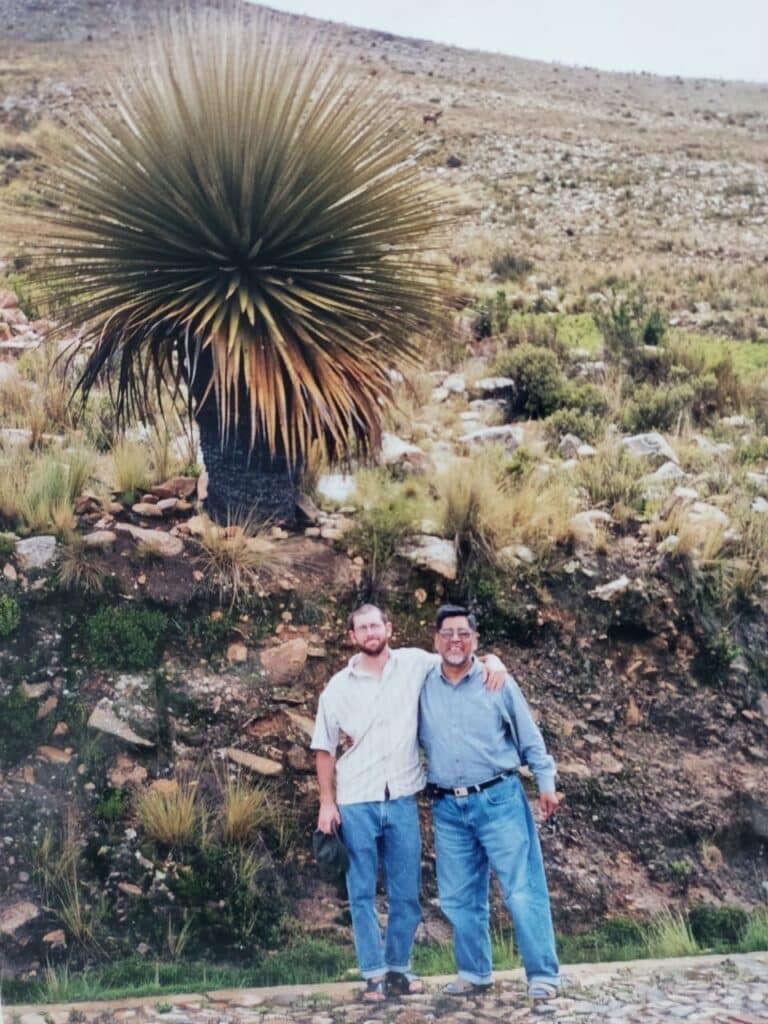
With PCV in arid, high valley
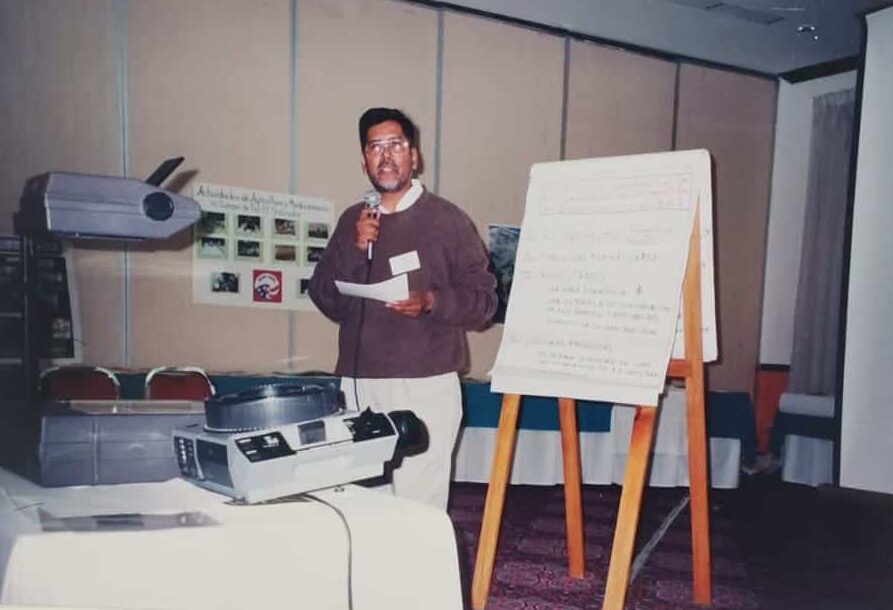
Remigio as teacher

