A Personal Poster Story
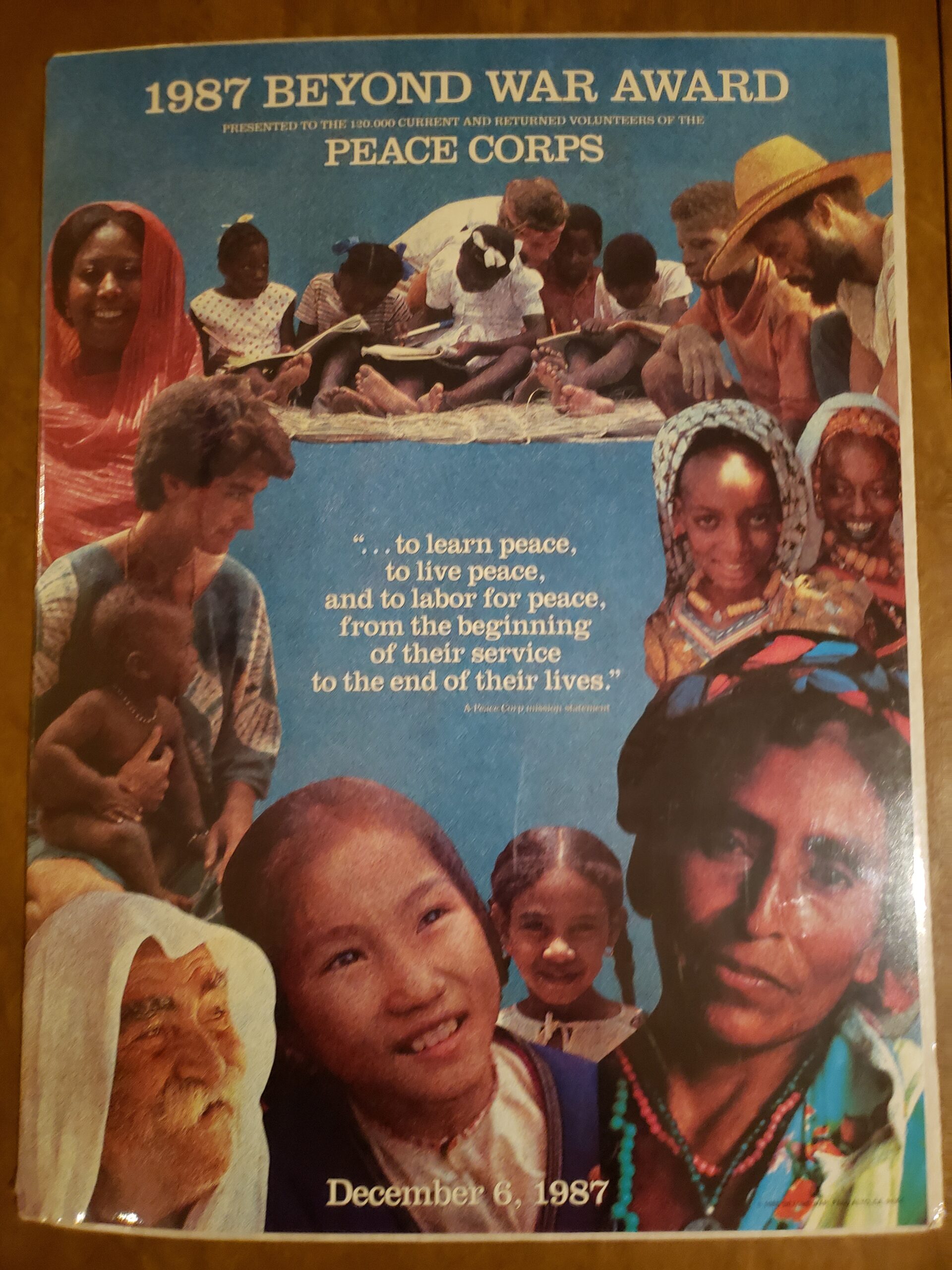
My eyes landed on Beyond War’s Peace Corps Award poster leaning upside down against a wall
Mike Abkin
Nigeria, 1966-68

It was a hot summer afternoon in Silicon Valley. Getting home from work, per usual, I turned first thing to the day’s mail. My eyes were drawn immediately to an official-looking envelope from some organization called The Beyond War Foundation. Intrigued, I opened it right away – and was thus launched down a new path of peace.
A shiver ran through me as my thoughts flew back to an earlier peace launching over 20 years before, when that PanAm Boeing 707 landed and opened the door of its air-conditioned cabin to a blast of hot, muggy air. Thus were my Peace Corps classmates and I welcomed to Lagos, Nigeria. We were each met by people from our host schools all over the country. I was posted to the town of Ondo in what was then Nigeria’s Western Region. Specifically, to Ondo Boys’ High School. My assignment for the next two years was to introduce French into the school curriculum.
But the Beyond War Foundation, what was that? I would later find out that BWF was an international movement of over 24,000 active members across the United States and around the world committed to spreading the understanding that, with humanity facing the threat of nuclear annihilation, war had become obsolete and that we must dedicate ourselves to the nonviolent resolution of conflicts. To that end, in addition to other outreach and educational programs, they celebrated, with the annual Beyond War Award, the outstanding efforts of individuals, groups, and nations to build a world beyond war. And this year, 1987, that award was being presented to the Peace Corps and it’s (at that time) over 120,000 past and present volunteers and staff – as announced by the poster on the right.
The formal invitation I received in the mail that day was to a lunch at the Los Gatos, California, home of a couple of Beyond War volunteers, both practicing medical professionals in the area. In attendance would be, in addition to the hosts, a half dozen returned Peace Corps volunteers in the area. And I was one of them!
My hosts were among the hundreds of Beyond War volunteers across the country who, in the months leading up to the award ceremony, were inviting local RPCVs to lunch or other such gatherings to honor and thank them for their service.
The award ceremony itself, recorded in this archival 79-minute video, took place at the San Francisco Masonic Auditorium and was broadcast live via satellite and cable television to millions of viewers in the United States and other countries. Included in the program were taped interviews with Sargent Shriver, Bill Moyers, and Richard Leakey, and live presentations by Peace Corps Director Loret Ruppe, National Council of RPCVs president Katy Hansen, and a number of PCVs, both returned and freshly minted and about to embark on their tours of service.
Four years later, the Soviet Union collapsed, the Cold War was declared over, and, signaling the greatly reduced threat of nuclear holocaust, the Doomsday Clock was wound back to 17 minutes before midnight, its earliest setting ever. With the criticality of its mission thus abated, the Beyond War Foundation morphed itself into the Foundation for Global Community with the expanded commitment to demonstrating and promoting the understanding that we are profoundly interconnected and interdependent as “One Earth, One Humanity, One Spirit”.
I hadn’t been active in Beyond War, but, after being inspired by that introduction in 1987, eagerly began taking courses and volunteering with FGC. So much so that I soon retired from my technical career of 34 years and hired on to the FGC staff. And I continued on that “new path of peace” with FGC and, later, other peacebuilding organizations.
In 2005, the Foundation for Global Community made the difficult decision to cease operations and liquidate its assets. While emptying closets of dusty memories of the past, my eyes landed on Beyond War’s Peace Corps Award poster leaning upside down against a wall of the community’s Palo Alto headquarters. I grabbed it and carried it off to my home, where I displayed it on my wall for almost 20 years. Until, upon hearing of the opening of the Museum of the Peace Corps Experience, I knew that poster had, at last, found its true home.