How four Peace Corps volunteers and Chief Justice of the Supreme Court
Warren Burger were lured to Bobbo’s loom
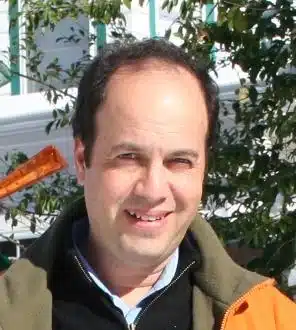
John Nash
Ghana 1988-90
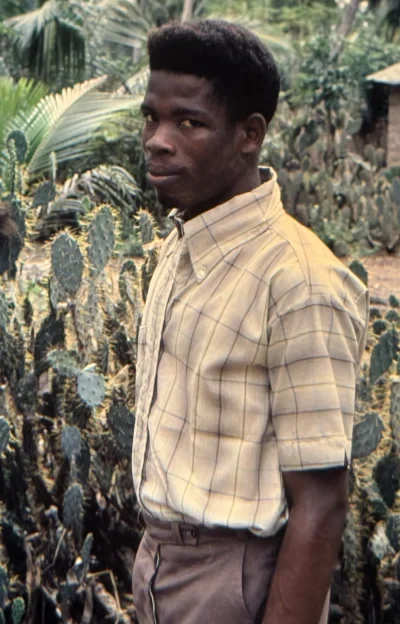
One day a weaver named Bobbo came to my school and introduced himself. He seemed eager to meet me. A week later I ran into him, and he reprimanded me for not having visited him at his home. I was meeting so many people as a new teacher at St. Paul’s Secondary School in Ghana’s Volta region that I don’t think I even remembered him. He was gracious.
No problem, he said, and invited me to his home for a meal the coming Sunday. I failed to go, not really knowing who he was or where he lived.
When we crossed paths again, I was embarrassed. He looked disappointed, but again graciously invited me to his house. “Take the main road to the ocean,” he said. “Before you reach the end of the road, ask anyone you see for the road to Bobbo’s house.” The following Sunday, unexpectedly, a car came to my house with a driver tasked with taking me to Bobbo’s house in Denu. I think he figured I was just going to keep forgetting.
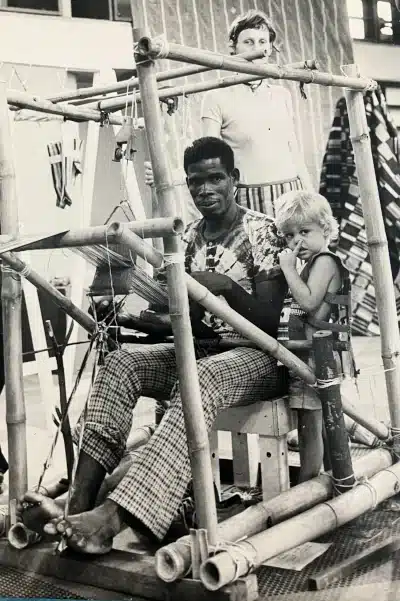
At Bobbo’s house I was served the best food I’d had yet in Ghana and met his wonderful family. I remember three of his sons – Billy, Grandy, and Chapuchi – were working the looms. They were bright, friendly and fun to talk to. After lunch Bobbo showed me his photo album, and I was surprised to see a photo of himself with Supreme Court Justice Warren Burger intently watching Bobbo demonstrate his weaving techniques in a museum in Washington, DC.
Bobbo became a lifelong friend. In time I came to understand why he had been so persistent in wanting to meet me. The reason was because of the previous great experiences he had with other Peace Corps volunteers in his life.
Teachers and advocates
The first two were Dave Hostetler, who arrived in Ghana in 1967, followed a year later by Frank Delano. Both were also his teachers at St. Paul’s Secondary School. Dave remembers Gilbert “Bobbo” Ahiagble as a diligent student whose goal was to become a school teacher. “Bobbo’s love of weaving and sharing his work with others was strong. He enjoyed telling us about his weaving and showing us his handiwork. Each traditional pattern had a name and special meaning,” Dave recalls.
Bobbo’s village was a center of Ewe-style Kente cloth production. He learned his craft from his father who was a master weaver in Agbozume. While other towns hold food markets every four days, Agbozume is known for its cloth market, where beautiful hand-woven Ewe textiles are sold.
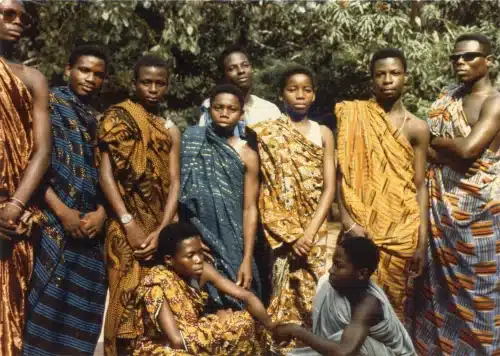
West African cloths are woven in long four-inch wide strips and sewn together in one large piece: a wrapper for women, or the men’s togas, which can be larger than a king- sized bedspread. Westerners are not likely to wear Kente cloths in this style, but after selling several long pieces to Dave and Frank, Bobbo realized there was a market for other formats of his strips and began joining them as shirts, place mats, and even pants.
He began visiting embassies in Accra. “With his friendly outgoing nature, he was able to take orders for various sizes and formats of cloth and create custom items on request,” Dave said. “He grew to consider himself an artist as well as a craftsman.”
Bobbo frequently told me about the important role that Dave and Frank played in his life. His American teachers’ appreciation of his craftsmanship that he received at a young age, and the interest that they showed in learning about his culture, would put him on the path to earning the title of Cultural Ambassador of Kente Cloth.
When some 40 years later Frank had the opportunity to visit Bobbo in Ghana, he said he was surprised to hear Bobbo credit him with launching his career. “He said that I was the first person to suggest making trousers from the bright striped fabric with its woven emblems. After I made the trousers for you, I went all around the country selling them to Peace Corps.” Frank recalled hearing from Bobbo. “Those were the days of hippie fashion.”
Taking his weaving shuttle to Washington
The next time Dave and Frank met Bobbo, he was seated at one of his hand-built looms at the Museum of African Art in Washington, D.C. in 1975. “That’s where Frank and I were reunited with our former student,” Dave recalls. The Washington Post reported that Secretary of State Henry Kissinger. Sen. Hubert Humphrey of Minnesota, and Supreme Court Chief Justice Warren Burger attended the event one day and chatted with Bobbo while he wove a panel of Ewe Kente cloth on his loom. And that event happened because of yet another Peace Corps volunteer.
Alan Brody had served his first Peace Corps tour elsewhere in Ghana, and returned in 1971 to wed Mary, a Ghanaian woman. Rejoining Peace Corps from the field in 1972, he spent another six years across various jobs. Alan’s uncle, Warren Robbins, was a cultural attaché and African art collector who quit the State Department to open the private Museum of African Art in 1964, focusing on education and cultural exchange. His collection later became the core of the National Museum of African Art established by the Smithsonian.
During home leave in 1974, Alan toured his uncle’s museum which was planning a large exhibition of textiles. “My uncle wanted to have some contemporary Ghanaian Kente cloth to sell in their gift shop during the exhibition.” He also asked Alan to look for a skilled Kente weaver who could come to Washington as the private museum’s artist-in-residence.
Alan purchased beautiful Kente cloths in Bonwire, the village where the best Ashanti Kente weavers work. But he couldn’t find a skilled weaver with the right communication skills until Patti Vanderberg, a former Peace Corps volunteer and friend in Accra, told him about the affable Bobbo. Alan discovered that Bobbo had already built a growing market among expats, producing Kente textiles in placemat and tablecloth designs. Alan encouraged Bobbo to expand his research “to master the techniques of some of the great weavers of previous generations.” Bobbo developed complex traditional patterns that incorporated animal figures into the designs, and produced pieces suitable for hanging.
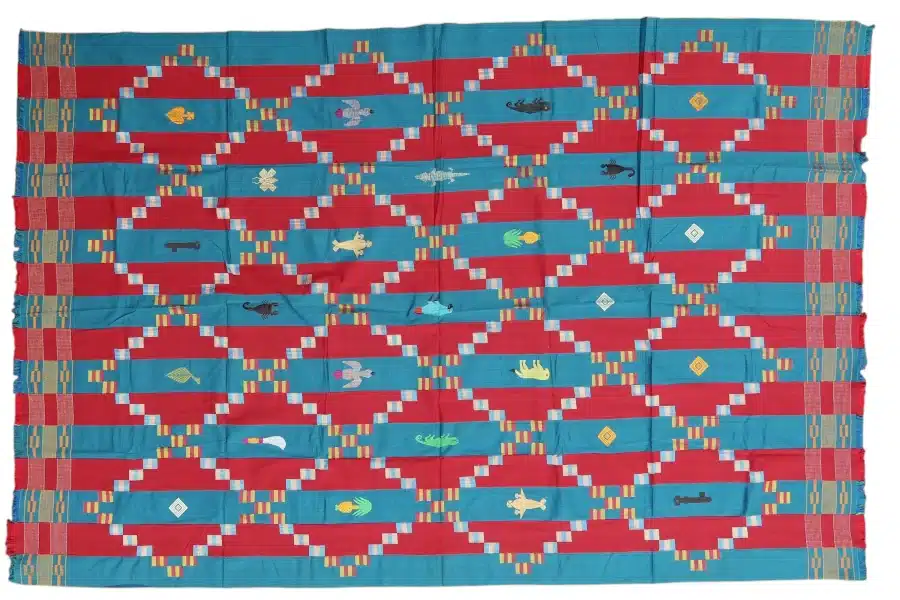
Alan shipped the classic Ashanti Kentes by air to his uncle, and arranged for Bobbo to go to Washington to demonstrate and lecture on his Ewe Kente weaving at the Museum’s African textiles exhibit.
And when on his 1976 Peace Corps home leave, Alan and his four-year-old son arrived, they were wearing matching Kente suits tailored by Bobbo in the style of American jeans jackets and pants. “Uncle Warren was dazzled,” Alan reports.
Early success on the web
My friendship with Bobbo also had a big impact on my life. Before I came home from Peace Corps, he gave me six particularly nice strips to gift to his friend, Louise Meyer. Louise had volunteered as Bobbo’s assistant during his residency at the museum. It was Bobbo’s first time away from home, Louise says, and “he welcomed our friendship and frequently walked over to my house when his workshops ended.” Bobbo was charmed by Louise’s infant son, Michael. “He missed his children.”
After Bobbo returned to Ghana, Louise’s family moved to nearby Côte d’Ivoire. “Working as his assistant in the museum greatly influenced my decision to find work promoting indigenous artisans in Côte d’Ivoire,” Louise recalls.
Louise and I also became good friends and together we created a website – a platform for information about African artisans, called AfricanCraft.com.
And I won’t forget the experience I had when, on a visit to Washington, D.C., Bobbo built a loom in my sister’s back yard where I learned to weave Kente. Side by side clacking our shuttles.
Three of Bobbo’s sons continue his work as weavers. And one, Chapuchi, continues in the United States as an educator demonstrating his traditional Ewe weaving. His work is available at our African Crafts website.
In the decades before his death in 2012, Bobbo traveled the world giving demonstrations-lectures at schools and prestigious institutions, throughout the United States, in Switzerland, Australia and New Zealand. He opened the Craft Institute of Kente Weaving in Denu, introducing traditional Ghanaian weaving to a global audience. His work is now among the permanent collections of the Smithsonian’s National Museum of African Art, the British Museum, and Santa Fe’s International Museum of Folk Art.