A math teacher conducted a cultural swap with the Shehu of Dikwa
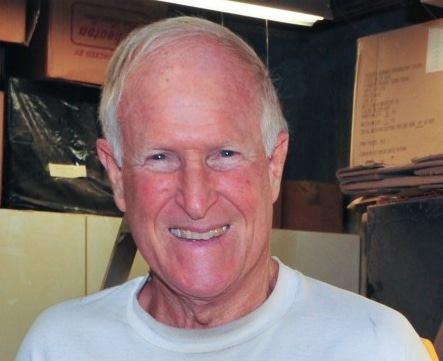
Blake Patterson
Nigeria 1963-1965
After a beautiful blond in Ann Arbor, Michigan dumped me, and not having other plans for my brand new Master’s degree in mathematics, I joined the Peace Corps and went to Nigeria expecting to serve in a university position.
A Peace Corps official took me aside as we waited for our flight to Nigeria and said that I would initially be assigned to a small rural town, Okene, but that soon I would transfer to a university. That was a lie. Though I was much appreciated in Okene, I soon realized that no one was working on the promised transfer. I had learned not to accept bad advice a couple of years earlier at Michigan when the marching-band director at Michigan suggested I drop the bassoon, so after endless procrastination from the office of the Peace Corps country director, I insisted, “Place me at a university or send me home.”
The move to the University of Ife in Ibadan as a math lecturer was good for me because it enriched my math skills and nurtured my bassoon playing via Ibadan’s classical-music scene. In Ibadan I met an excellent British flutist/dermatologist and with a handful of others put on chamber-music concerts. I still recall the joy of playing in orchestras for “The Mikado” and “Gianni Schicchi” for the first time. There were no high-calibre musicians to interact with in Okene!
Battling Masterson
Alan Weiss was a friend from the Nigeria VII training group who was constantly writing notes during lectures that, in retrospect, became the basis for a book about his Peace Corps experience called “High Risk, High Gain.” I was a minor character in the book, a “good mathematician” whom Alan called Battling Masterson because I fought the establishment. Alan and I ended up faculty colleagues at Ife University, but he quit Peace Corps early because agency functionaries wouldn’t let him bring his girlfriend/wife to Nigeria. Alan continued his teaching at the university as a civilian, which allowed him to own a small car.
In July, 1964, I rented his car and made a solo trip clockwise around Nigeria. From Ibadan in the southwest I headed to the northwest corner, then due east to Maiduguri in the northeast, then south to Igbo country and Cameroon. West from there brought me home to Ibadan.

Giving up my frisbee
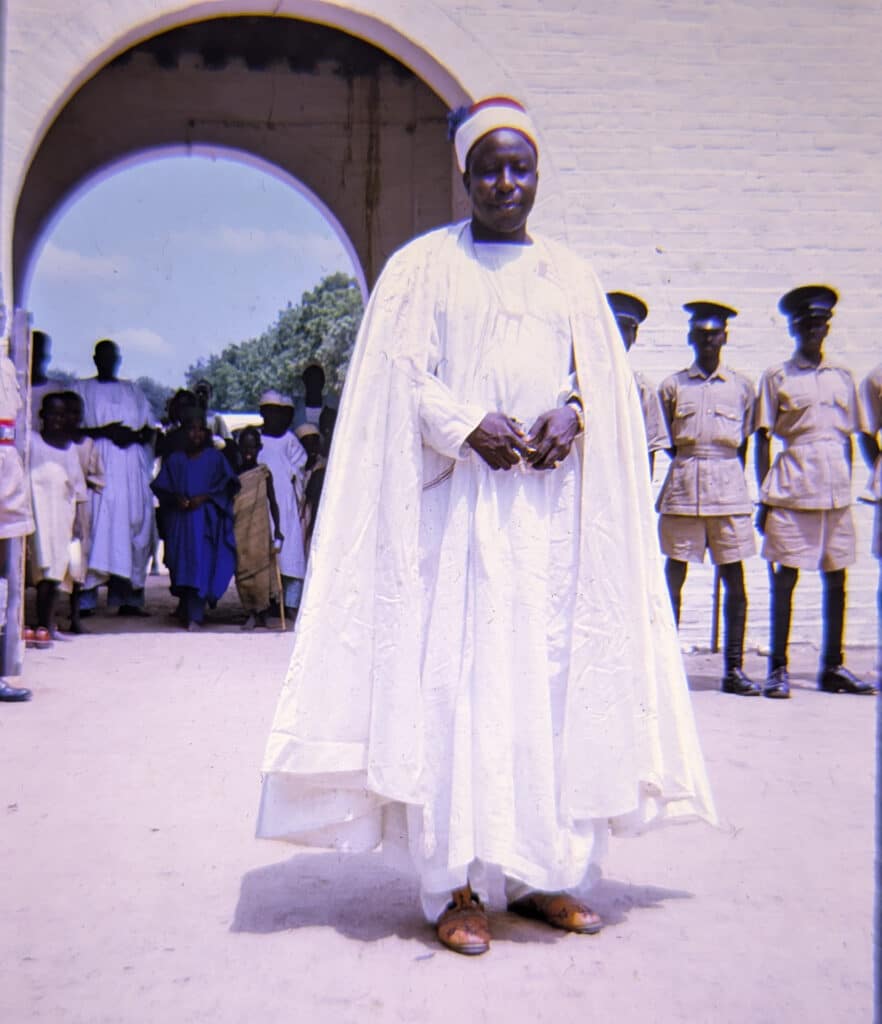
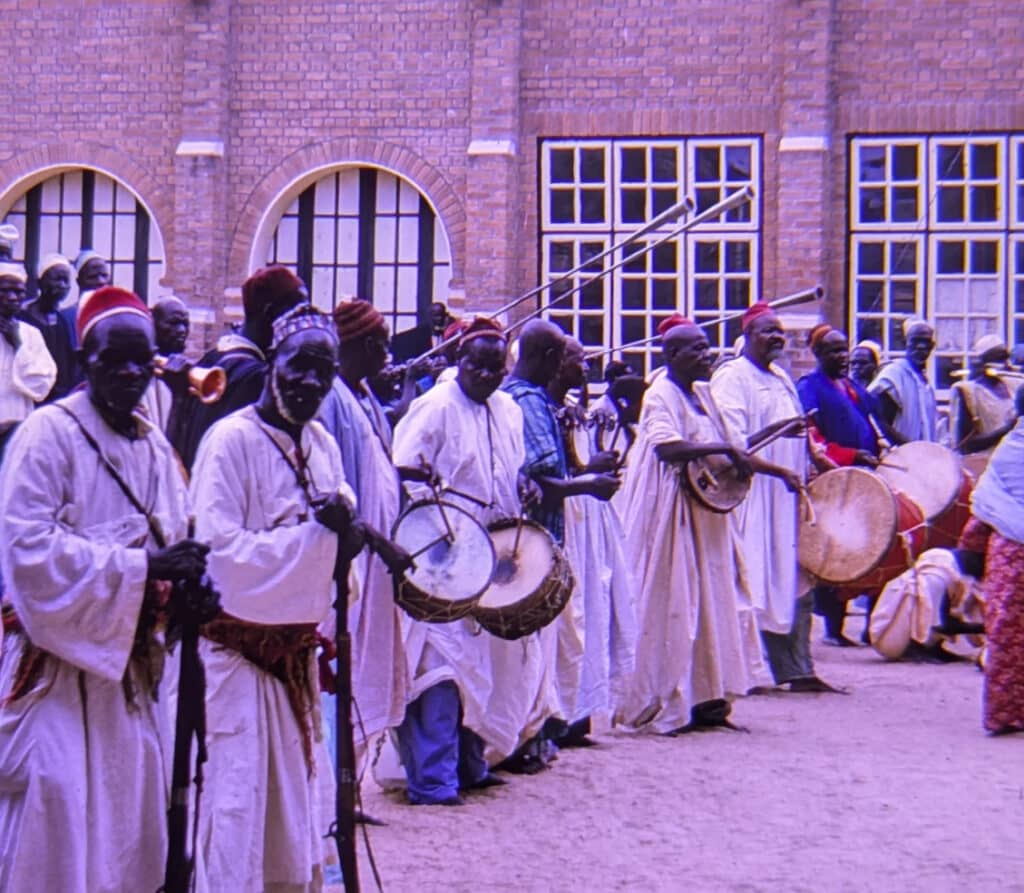
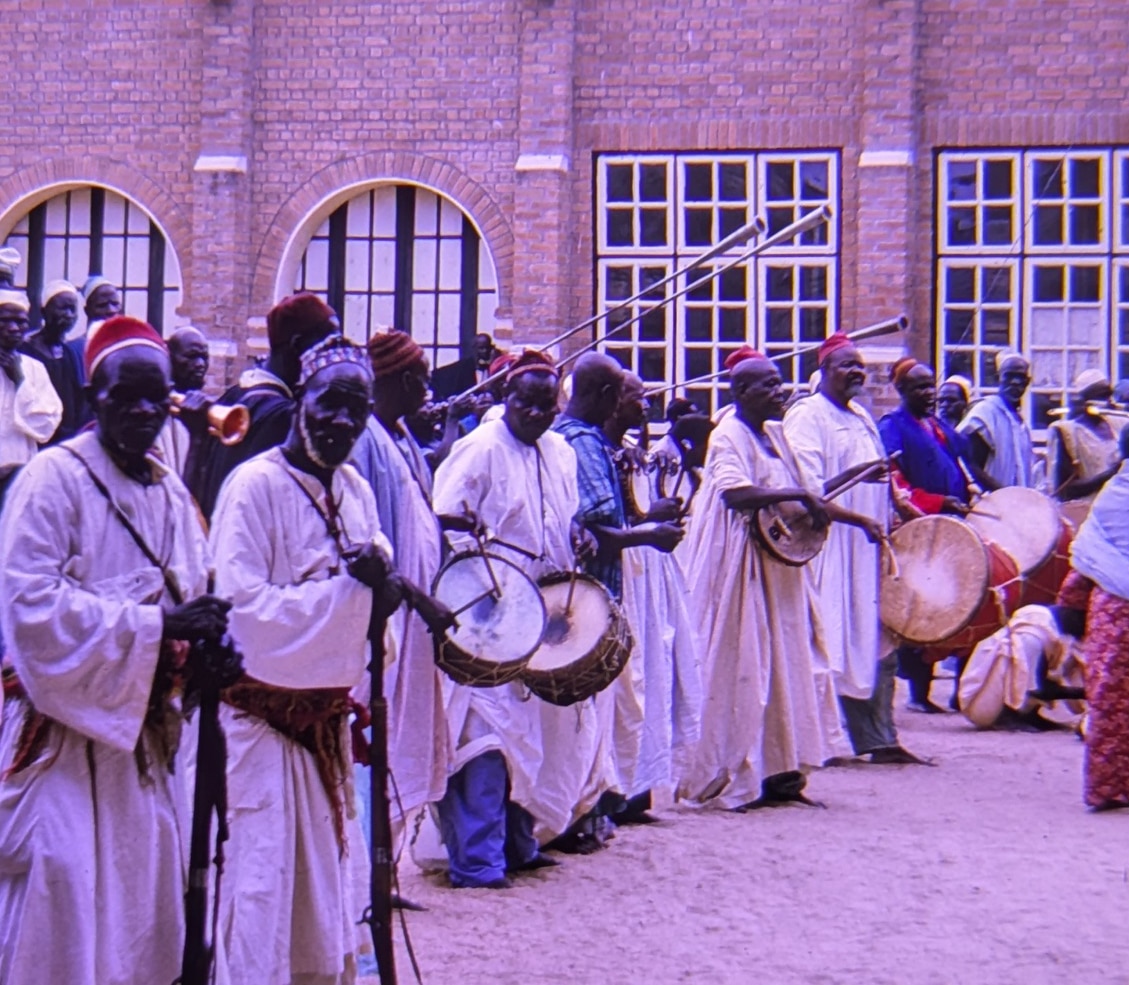
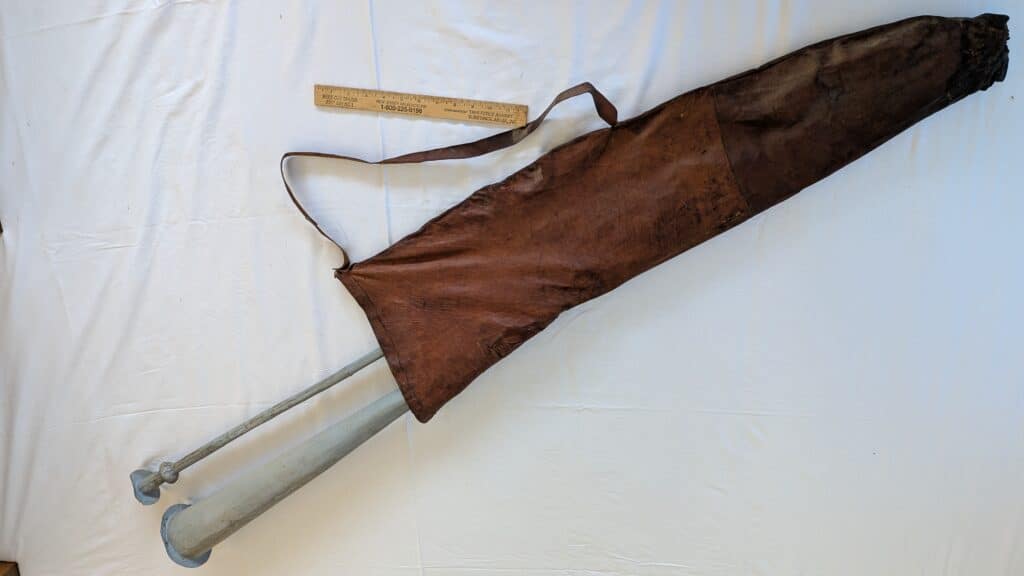
When I was in Maiduguri I briefly met the Shehu of Dikwa. I happened to be there during a celebration called a “Durbar” and watched Nigerian musicians playing a kakaki, a nine-foot-long trumpet handcrafted of tin by local blacksmiths. I got someone’s attention and said that I would like to buy a kakaki. To my amazement the Shehu, a god-like king/emir/sheikh, met me and said very politely that kakakis are expensive and difficult to obtain, but he gave me one. All I had to offer in return was my frisbee, which was perhaps the first frisbee in Nigeria. He graciously allowed me to take his picture. We didn’t talk long, probably not about music. He was a real VIP.
As a practice, Peace Corps provided each volunteer a footlocker for shipping personal belongings home when service ended. A friend had nothing to ship home so I used his footlocker to ship possessions that didn’t fit in my footlocker—including woodwind instruments, talking drums, other artifacts of Nigeria, and my two-piece nine-foot-long kakaki—back home to Detroit.
I later received a Ph.D. in physics from the University of California at Berkeley but before I was hired by Bell Telephone Labs my first job was playing second bassoon in the New Jersey Symphony. I met Ellen Jackson at the symphony in 1973 and we’ve been together ever since. We bought a 30-room fixer-upper in Rumson, New Jersey that we renovated top to bottom. Ellen took up the cello and we hosted dozens of chamber music concerts there.
Among the Nigerian wind instruments I possess are the “shila-shila,” an edge-blown flute that has confounded countless western-style flutists who are unable to make a sound on it. Another is an “algaita” a loud oboe-like instrument played with a circular-breathing technique. I often demonstrated the algaita until I discovered that it was sickening me with giardiasis, an intestinal-parasite disease. However, the kakaki has been tooted by many friends and remains a playable instrument.